 Batteries



 Power supplies

 UPS (Uninterruptible power supply)


 Electric car chargers

 Solar panel systems
 Chargers

 Power Inverters



 Cables

|
The role of solar charge controllers |
Without them, the system would be less efficient and could even be damaged, which is why it’s worth getting to know them better.
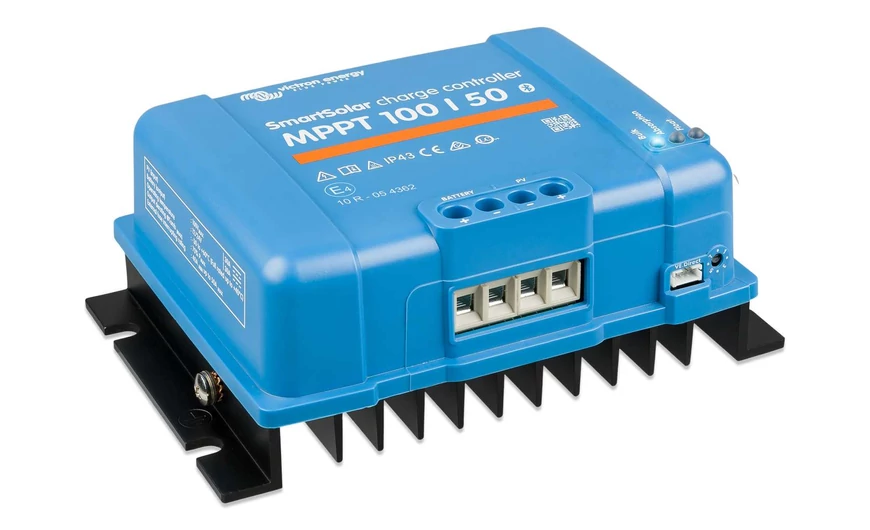
The role of solar charge controllers is to continuously regulate the flow of energy between the panels and the batteries, preventing overcharging, deep discharging, and energy loss.
They do all this quietly and automatically, but without their operation, the system’s lifespan would be drastically reduced.
Solar panels do not produce a constant amount of power: on a clear summer morning they can generate a large amount of energy, while on a cloudy autumn afternoon only a fraction of that.
The charge controller’s job is to balance this fluctuation and ensure that only as much energy flows into the battery as it can safely receive.
It also prevents the battery from “feeding back” energy at night when there is no production, as that could damage the entire system.
Of course, today’s modern solar charge controllers do much more than just provide protection.
Thanks to their smart design, they can continuously monitor voltage, temperature, and even overall system efficiency.
Some models can be controlled via Bluetooth or Wi-Fi, allowing the user to see on their smartphone how much energy the system produces, how the battery charge changes, and how the solar panels are performing.

|
|
What types are available? |
Solar charge controllers can basically be divided into two main categories: PWM (Pulse Width Modulation) and MPPT (Maximum Power Point Tracking) types. The difference between the two solutions is also significant in terms of efficiency. PWM controllers represent the older but reliable technology. Their operation is based on regulating the voltage difference between the solar panel and the battery through pulses.
This is a relatively simple and inexpensive method, but it also has disadvantages: it cannot always utilize the full power of the solar panels, especially when light conditions change frequently. Therefore, their efficiency usually ranges around 70–80%.
In contrast, MPPT charge controllers represent modern technology. They continuously monitor the current performance of the solar panels and always adjust the system’s operation to extract the maximum possible energy from sunlight. In practice, this can result in 20–30% higher efficiency, especially in winter or in partially shaded areas.
|
|
They are indispensable in solar systems. |
Solar charge controllers are not “extra” accessories; they are one of the most important components for protection and optimization. They ensure that the solar system operates reliably even under extreme conditions.
In the long term, investing in such a device is definitely worthwhile. The right model can easily be found in our online store.